

What's included
- An assessment before any machine is used, looking at your pain, movement, mobility, posture and the everyday things you are finding hard.
- A check for the reasons decompression must not be used on you, including pregnancy, a fracture, a tumour, osteoporosis and metal implants in the spine.
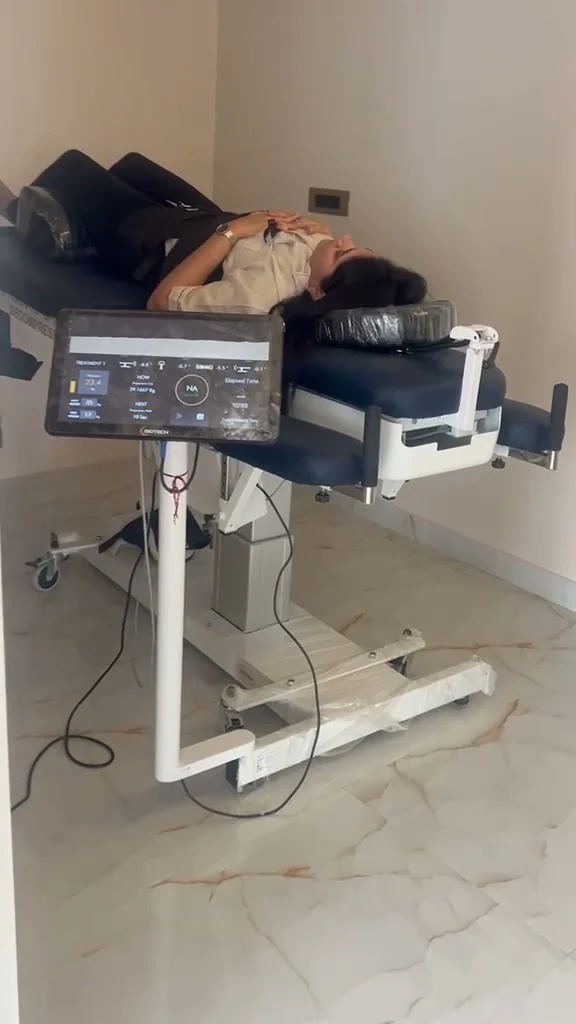
- Set-up on the decompression table by a physiotherapist: a harness around your chest, a belt around your pelvis and a support under your knees, as the setting-up video below shows.
- A pulling force set by the physiotherapist on the table's touchscreen console, as the videos below show.
- Decompression used as one part of a plan that can also include exercise therapy and manual therapy, all on site.
- Consultation in Hindi, English or Rajasthani.
Who it's for
This treatment suits some people and not others. It is worth a call if you recognise yourself here.
- Adults with low back pain, with or without pain down the leg, who are willing to have a full physiotherapy assessment first.
- People told they have a slip disc or sciatica who want to know whether decompression suits them.
- People who want the limits of the treatment explained, including the guidance that advises against it, before they decide.
Who should not have it
Published health sources rule spinal decompression out in these cases:
- Pregnancy.
- A fracture, a tumour or a spinal infection.
- Pressure on the spinal cord, for example from a tumour or a central disc herniation.
- Osteoporosis.
- Metal implants in the spine.
- An abdominal aortic aneurysm.
- Rheumatoid arthritis, or another joint condition with active inflammation.
Extra care is needed with very loose or hypermobile joints, claustrophobia, a heart or breathing condition, or if traction has made your symptoms worse before. Tell the physiotherapist about any of these, and about any surgery on your spine.
Not for an emergency. Go to a hospital emergency department straight away, not to the clinic, if you have sciatica in both legs, weakness or numbness in both legs that is severe or getting worse, numbness around your genitals or bottom, or new trouble starting or controlling your bladder or bowels.
How it works
- Assessment before the table A physiotherapist asks about your pain, your health and any surgery or implants in your spine, examines your back and legs, and checks the reasons decompression would not be safe for you. Decompression is not a diagnosis. If your pain is new, severe, came after a fall, or comes with numbness, weakness, fever or unexplained weight loss, you will be advised to see a doctor first.
- Setting up You stay fully clothed. You lie on your back on the table with a support under your knees, and the physiotherapist fastens a harness around your chest and a belt around your pelvis. The setting-up video below shows each step at the centre.
- During the session The physiotherapist sets the pulling force on the console, which shows the time and the force while the session runs. You will feel the pull through the harness and the belt. Tell the physiotherapist at once if it hurts, or if leg pain, numbness or tingling gets worse, so the force can be lowered or the session stopped. Side effects have been reported in research: in the 2013 Cochrane review, 7 of the 32 studies reported them, including more pain, worse nerve symptoms and later surgery.
- Decompression sits inside a wider plan In the same programme the physiotherapist may use manual therapy, myofascial release, Mulligan Concept mobilisation with movement, kinesiology taping and the exercise therapy you continue at home. Other equipment on site, including Class IV laser and TECAR therapy, is used only where the assessment calls for it. The Spine, Back and Neck Care page describes the fuller pathway.
- How many sessions That depends on your assessment, so this page does not set a number. Ask your physiotherapist what they suggest and why, and how progress will be judged. Responses differ from one person to the next.
What Is Spinal Decompression Therapy?
Spinal Decompression Therapy is a non-surgical, traction-based physiotherapy technique that applies a controlled pulling force to the neck or lower back. The equipment allows force, position and timing to be adjusted according to comfort and tolerance.
Unloading describes how the treatment is delivered. Responses vary, and symptom relief alone does not establish a structural change in a spinal disc.
At Trivayu Physio Center, spinal decompression can form part of a comprehensive spine rehabilitation program alongside mobility, strengthening and movement-based physiotherapy.
Benefits of Advanced Technology
Technology features and their possible role in your rehabilitation.
Controlled Unloading
Applies an adjustable pulling force to the spine. The clinician selects the position and loading pattern, checks comfort and monitors how symptoms respond during and after treatment.
Regional Application
Treatment can be directed to a selected spinal region. Whether this produces a useful clinical benefit depends on the diagnosis and response, rather than on the equipment alone.
Adjustable Force
Treatment intensity, duration and positioning can be modified according to the patient’s symptoms, tolerance and response, allowing a more individualized and controlled rehabilitation experience.
Symptom Monitoring
A monitored trial, when clinically justified, allows the physiotherapist to check whether symptoms change. Any relief is reviewed alongside movement and function rather than assumed to reflect disc healing.
Rehab Readiness
Where comfort improves, the aim is to support participation in mobility, strengthening and movement exercises. Active rehabilitation continues to guide the longer-term plan.
Who Can Benefit?
People with the following concerns may seek a spine assessment. Your physiotherapist should explain which options have evidence for your presentation and whether traction has a justified role:
- Herniated or slipped disc symptoms
- Disc-related lower back pain
- Disc-related neck pain
- Sciatica
- Lumbar radicular symptoms
- Mechanical lower back pain
- Mechanical neck pain
- Cervical spondylosis
- Selected degenerative spinal conditions
A diagnosis alone does not establish that decompression will help. Assessment, relevant clinical guidance and your response determine the appropriate rehabilitation plan.
Your Next Step Towards Better Movement
If neck or back pain is limiting movement, work or everyday activities, book an assessment at Trivayu Physio Center in Jaipur to discuss appropriate treatment options and a personalised spine rehabilitation plan.
Move Better. Feel Stronger. Get Back to Life.
Common questions
What is spinal decompression therapy?
Spinal decompression therapy is motorised traction on a computer-controlled table. A harness around the chest and a belt around the pelvis hold you while the table applies a pulling force set by the physiotherapist. At Trivayu Physio Center in Vaishali Nagar, Jaipur it is listed as robotic spinal decompression and is used only after a physiotherapy assessment.
Is spinal decompression the same as traction?
Spinal decompression works on the same basic principle as spinal traction, using a motorised, computer-controlled table. Ordinary traction can also be given by a motorised machine. A 2024 study in Cureus (Adar and colleagues) looked back at the records of 45 patients given decompression and 36 given conventional motorised traction, both alongside physiotherapy, and found the results appeared similar. The word robotic refers to the computer control and is not a medical category.
What does spinal decompression feel like?
You will feel the pull of the chest harness and the pelvic belt while you lie on your back, fully clothed. The physiotherapist sets the force and can lower it. Tell them at once if it hurts, or if leg pain, numbness or tingling gets worse during or after the session.
Who should not have spinal decompression?
Published health sources rule spinal decompression out in pregnancy, and with a fracture, a tumour, a spinal infection, pressure on the spinal cord, osteoporosis, metal implants in the spine, an abdominal aortic aneurysm, or rheumatoid arthritis or another joint condition with active inflammation. Extra care is needed with very loose or hypermobile joints, claustrophobia, a heart or breathing condition, or if traction has made your symptoms worse before. Tell the physiotherapist about any of these, and about any surgery on your spine. Spinal decompression is not a treatment for an emergency. Go to a hospital emergency department straight away, not to the clinic, if you have sciatica in both legs, weakness or numbness in both legs that is severe or getting worse, numbness around your genitals or bottom, or new trouble starting or controlling your bladder or bowels.
Does spinal decompression work for a slip disc or sciatica?
The evidence for spinal decompression in low back pain and sciatica is weak. A 2013 Cochrane review (Wegner and colleagues, 32 trials, 2,762 people) found traction had little or no effect on pain, and probably no effect in sciatica. The UK's NICE guideline NG59 says not to offer traction for low back pain with or without sciatica. A 2006 review of motorised decompression in Pain Practice (Macario and Pergolizzi) found 6 of 7 controlled trials showed no difference from the comparison treatment. A 2021 review in Physical Therapy (Vanti and colleagues) found a short-term benefit when traction given lying on the back was added to physiotherapy for leg pain from a trapped nerve, but those trials were of low quality, and the better-quality trials, which gave traction lying face down, found no clear benefit.
Can spinal decompression help me avoid surgery?
Spinal decompression cannot promise that, and no physiotherapy treatment should. Decisions about surgery belong with your doctor or spine surgeon. If you have been advised to have surgery, bring the report to the assessment.
Is spinal decompression FDA approved?
In the United States, the FDA clears spinal decompression tables one model at a time, as powered traction equipment, through the 510(k) route. Clearance is not approval: US rules say a 510(k) clearance does not denote official approval of the device. Clearance also does not show that the treatment works.
Where can I get spinal decompression in Vaishali Nagar, Jaipur?
Trivayu Physio Center is at 204, 2nd Floor, Om Tower, Gandhi Path Road, Nemi Nagar, Vaishali Nagar, Jaipur 302021. It is open Monday to Saturday, 8:00am to 8:00pm, and Sunday, 10:00am to 1:00pm. Call or WhatsApp +91 90570 65065 to ask whether spinal decompression suits your problem before booking. Consultations are in Hindi, English and Rajasthani. There are also branches at Vidyadhar Nagar and Rangoli Gardens, which keep different hours; ask before visiting a branch whether spinal decompression is available there.
See it in the physiotherapy clinic
Filmed at our centre in Vaishali Nagar, so you can see what the session actually looks like before you book.
Further reading
This page is educational and does not replace a proper assessment. Outcomes vary by individual; Trivayu Physio Center makes no guarantee of specific results.
Patient information published by Trivayu Physio Center.