

What's included
- An assessment before any machine is used, looking at your pain, movement, mobility, posture and the everyday things you are finding hard.
- A check for the reasons laser must not be used on you, or must not be used over a particular area, including pregnancy, cancer, a bleeding problem and a clot in a vein.
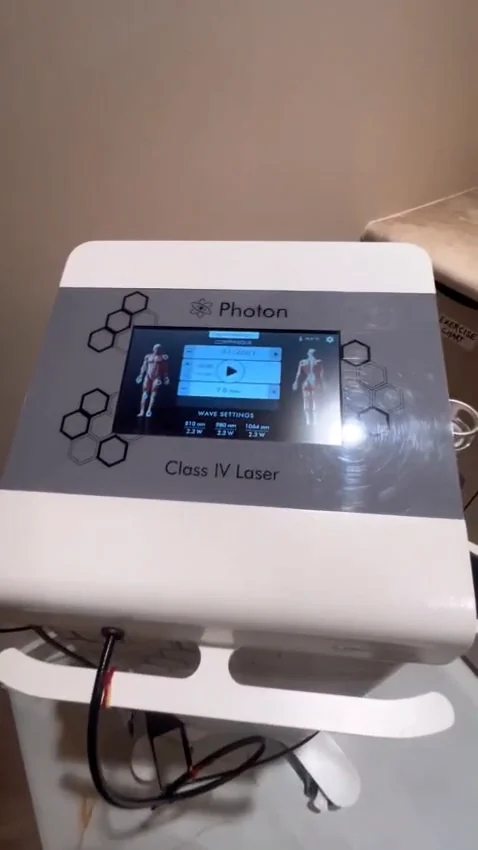
- Where the assessment supports it, treatment on the Photon Class IV laser unit at the Gandhi Path centre in Vaishali Nagar.
- Laser safety glasses for the physiotherapist, as the shoulder video on this page shows. Class IV safety rules call for eye protection for everyone in the room, you included, so ask for a pair before the laser is switched on.
- Laser used as one part of a plan that can also include manual therapy, exercise therapy and kinesiology taping, all on site.
- Consultation in Hindi, English or Rajasthani.
Who it's for
This treatment suits some people and not others. It is worth a call if you recognise yourself here.
- Adults with muscle or joint pain who are willing to have a full physiotherapy assessment first.
- People with knee, neck or low back pain, three of the areas where high-intensity laser has been studied, and where the evidence is still of low certainty.
- People with a sports injury, one of the uses Dr. Jyoti Choudhary names in her laser video. The Sports Injury and Rehab page covers the wider plan.
- People who want the limits of the treatment explained as well as the possible benefit.
Who should not have it
Physiotherapy safety guidance, written for lower-power lasers, says laser should not be used in these cases:
- Over the eyes, or over the testes.
- Over a known or suspected cancer.
- Over the low back, abdomen or pelvis during pregnancy.
- Over an active or suspected clot in a vein (deep vein thrombosis), or an inflamed vein.
- On tissue that is bleeding, or if you have a bleeding disorder that is not being treated.
- If you have tuberculosis, or over tissue with another serious bacterial infection.
The same guidance calls for extra care with skin treated with radiotherapy recently, lupus or another light-sensitivity condition, an infection when your immunity is low, a child's growing bones near the area, and the front of the neck. Because a Class IV laser heats the tissue, numbness or reduced feeling over the area, or anything that makes it hard for you to tell the physiotherapist at once that it feels too hot, may rule it out. Tell the physiotherapist about any of these.
How it works
- Assessment before any laser is used A physiotherapist asks about your pain, your health and your medicines, examines the painful area, and checks the reasons laser would not be safe for you. Laser is not a diagnosis. If your pain is new, severe, came after a fall, or comes with numbness, weakness, fever or unexplained weight loss, you will be advised to see a doctor first.
- Eye safety, then the probe Class IV safety rules call for laser safety glasses for everyone in the room, you included, because the beam can harm the eyes, even by reflection. The physiotherapist then holds the handheld probe on or just above the skin and moves it over the area. The shoulder video below shows how it is done at the centre.
- What it feels like You may feel mild warmth, or nothing much at all. Tell the physiotherapist straight away if it feels hot, so the settings or the probe can be changed, and tell them if your skin looks red or blotchy afterwards.
- Laser sits inside a wider plan In the same programme the physiotherapist may use manual therapy, myofascial release, Mulligan Concept mobilisation with movement, kinesiology taping and the exercise therapy you continue at home. Other equipment on site, including TECAR therapy and spinal decompression, is used only where the assessment calls for it.
- How many sessions That depends on your assessment, so this page does not set a number. In the knee osteoarthritis trials in a 2022 review in Frontiers in Medicine (Wu and colleagues), people had between 7 and 30 sessions over 2 to 6 weeks, where the trials reported it. Those figures come from research, not from Trivayu. Ask your physiotherapist what they suggest and why, and how progress will be judged. Longer-standing pain that needs a broader plan is handled through Pain Management.
What Is Therapeutic Laser Therapy?
Therapeutic Laser Therapy is a non-invasive modality that delivers specific wavelengths of light to a treatment area. It may be considered for selected musculoskeletal pain conditions alongside exercise and movement-based rehabilitation.
The treatment is used in physiotherapy to support pain relief, reduce sensitivity and improve function in selected musculoskeletal conditions. Depending on the system used, treatment may involve low-level or higher-intensity laser technology.
At Trivayu Physio Center, Laser Therapy is integrated with exercise, strengthening and movement-based rehabilitation. Its role and expected response depend on the diagnosis, laser parameters and your functional goals.
Benefits of Advanced Technology
Technology features and their possible role in your rehabilitation.
Targeted Phototherapy
Delivers controlled light energy directly to the treatment area, allowing a focused non-invasive approach for selected painful musculoskeletal and soft-tissue conditions.
Pain Modulation
For some conditions, an appropriately dosed laser may offer short-term pain relief. Response is monitored alongside exercise tolerance and function, rather than taken as evidence of faster tissue healing.
Low-Load Delivery
Depending on the applicator, treatment may use contact or non-contact techniques. Delivery does not require forceful joint loading, and the approach is selected for the person and treatment area.
Adjustable Delivery
The treatment area and light dose can be selected for the clinical goal, with comfort and skin response checked during care. The settings depend on the system being used.
Exercise Readiness
When discomfort reduces, patients can often move and exercise more comfortably, improving participation in mobility, strengthening and functional rehabilitation.
Who Can Benefit?
Therapeutic Laser Therapy can be considered for selected patients with:
- Neck and shoulder pain
- Tendon-related pain
- Tennis elbow
- Plantar fasciitis
- Soft-tissue injuries
- Muscle strains
- Persistent musculoskeletal pain
- Selected sports injuries
Your Next Step Towards Better Movement
If pain or soft-tissue irritation is limiting your movement, exercise or daily activities, book an assessment at Trivayu Physio Center, Jaipur and discover whether Therapeutic Laser Therapy can support your rehabilitation.
Reduce Pain. Restore Movement. Support Recovery.
Common questions
What is Class IV laser therapy?
Class IV laser therapy uses a laser above 0.5 watts, the power level that laser safety rules call Class IV, to send light into the tissue under the skin. In research it is called high-intensity laser therapy. At this power the light warms the tissue, unlike low-level laser therapy, which works without heating. At Trivayu Physio Center in Vaishali Nagar, Jaipur it is used only after a physiotherapy assessment.
Does laser therapy hurt?
You may feel mild warmth during laser therapy, or very little. Tell the physiotherapist straight away if it feels hot, because a Class IV laser can burn the skin, and tell them if your skin looks red or blotchy afterwards.
Is Class IV laser therapy safe?
Class IV laser therapy carries known risks, and the safety rules for this laser class exist to control them. The beam can cause permanent eye damage, even by reflection, so the rules require laser safety glasses for everyone in the room while it is on. It can also burn the skin, so tell the physiotherapist at once if it feels hot, and mention any numbness over the area. Physiotherapy safety guidance, written for lower-power lasers, rules laser out over the eyes, over a known or suspected cancer, over an active or suspected clot in a vein, and over the low back, abdomen or pelvis in pregnancy.
Who should not have laser therapy?
Physiotherapy safety guidance, written for lower-power lasers, says laser should not be used over the eyes or the testes, over a known or suspected cancer, over the low back, abdomen or pelvis during pregnancy, over an active or suspected clot in a vein, or an inflamed vein, on tissue that is bleeding or if you have an untreated bleeding disorder, or if you have tuberculosis. The same guidance calls for extra care with skin treated with radiotherapy recently, lupus or another light-sensitivity condition, an infection when your immunity is low, a child's growing bones near the area, and the front of the neck. Because a Class IV laser heats the tissue, numbness or reduced feeling over the area, or anything that makes it hard for you to tell the physiotherapist at once that it feels too hot, may rule it out. Tell the physiotherapist about any of these.
Does laser therapy work for knee pain and back pain?
Laser therapy may reduce knee and back pain for a while, but the evidence is limited. A 2022 review in Frontiers in Medicine (Wu and colleagues, 10 trials, 580 people with knee osteoarthritis) found more pain relief with high-intensity laser than with placebo laser or exercise alone, by an amount large enough for patients to notice, measured at the end of treatment, which in most of the trials lasted 4 to 6 weeks; the change in stiffness was too small for patients to notice. A 2018 review in Medicine (Song and colleagues, 12 trials) found less pain and disability in neck and low back pain, with follow-up of 12 weeks at most. A 2023 review in the Journal of Clinical Medicine (Arroyo-Fernández and colleagues, 48 trials) rated the certainty of the pain evidence as low.
Is this the same laser used for hair removal?
Lasers are used in physiotherapy as well as for hair removal, with different equipment, settings and purpose. A physiotherapy laser is used on painful muscles and joints. In the explainer video on this page, Dr. Ishu Sharma asks whether laser is only for hair removal, and Dr. Jyoti Choudhary explains that laser is used in physiotherapy too.
How many laser therapy sessions will I need?
The number of laser sessions depends on your problem and is decided after the assessment, so this page does not give a number. In the knee osteoarthritis trials in a 2022 review in Frontiers in Medicine (Wu and colleagues), people had between 7 and 30 sessions over 2 to 6 weeks, where the trials reported it. Those numbers come from research, not from Trivayu. Ask your physiotherapist what they suggest and why, and how progress will be judged.
Where can I get Class IV laser therapy in Vaishali Nagar, Jaipur?
Trivayu Physio Center is at 204, 2nd Floor, Om Tower, Gandhi Path Road, Nemi Nagar, Vaishali Nagar, Jaipur 302021. It is open Monday to Saturday, 8:00am to 8:00pm, and Sunday, 10:00am to 1:00pm. Call or WhatsApp +91 90570 65065 to ask whether laser therapy suits your problem before booking. Consultations are in Hindi, English and Rajasthani. There are also branches at Vidyadhar Nagar and Rangoli Gardens, which keep different hours; ask before visiting a branch whether laser therapy is available there.
See it in the physiotherapy clinic
Filmed at our centre in Vaishali Nagar, so you can see what the session actually looks like before you book.
See it explained
Filmed at our physiotherapy clinic in Vaishali Nagar. In this short video in Hindi, Dr. Ishu Sharma asks whether laser is only for hair removal, and Dr. Jyoti Choudhary describes where laser is used in physiotherapy. What the research shows, and its limits, is set out in the questions above.
Further reading
This page is educational and does not replace a proper assessment. Outcomes vary by individual; Trivayu Physio Center makes no guarantee of specific results.
Patient information published by Trivayu Physio Center.