

Is Side Bending Safe with L4 L5 Herniated Disc
An L4 L5 herniated disc happens when the disc between your fourth and fifth lumbar vertebrae bulges or ruptures. This presses on nearby nerves, causing pain…
Read article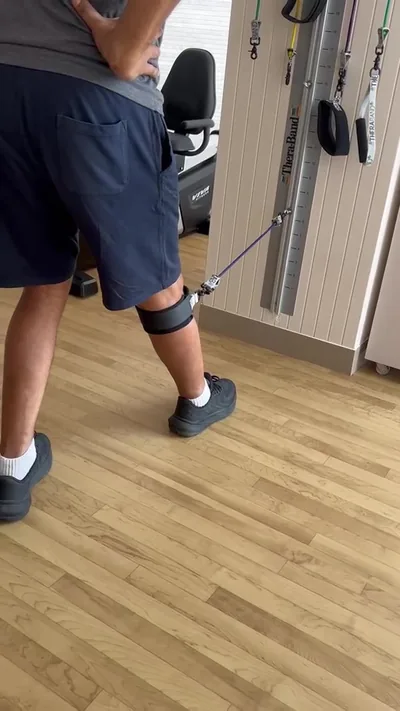
After ACL reconstruction, month 4 marks a key shift to quad and hamstring strength. Fitness enthusiasts often ask about safe leg press loads for gym return. This guide details practical steps for leg press, strength training, and full knee rehab gym routines at this stage.
Progress varies with healing, graft type (like hamstring or patellar tendon), prior fitness, and pain levels. Always get physio clearance before adding loads. Rushing invites graft strain or instability.
Expect gradual strength work under supervision. Leg press helps quads and overall leg power if form stays perfect. Watch for pain, swelling, or giving way. Physios assess form, adjust angles, and pair with balance drills. Manual Therapy eases any tightness from scar tissue buildup.
ACL recovery follows clear phases after surgery. Months 1-2 protect the new graft and regain knee bend and straightening. Month 3 adds walking without crutches and light resistance. By month 4, focus turns to building muscle power and knee stability for daily tasks and gym basics.
You should walk with a normal stride by now, bend the knee near fully, and straighten it completely. Physios test readiness with single-leg stands (hold 30 seconds without wobble), controlled squats to 60 degrees, or hop tests for control.
Risks of early heavy loads include graft stretching, swelling from overload, or quad shutdown where the muscle fails to fire properly. Physios measure quad girth (thigh circumference) to spot weakness, test knee laxity with manual drawers, and check range of motion. Looking for a Rehabilitation Centre Near Me? Our team in Vaishali Nagar, Jaipur can assess you in person.
Orthopaedic Rehabilitation at this stage includes hop tests on flat ground—single-leg, 5 reps without pain or instability. If cleared, introduce gym machines with strict limits. Track daily pain on a 0-10 scale; anything over 3 during exercise means back off.
Leg press can be safe post-ACL at month 4 if set up correctly and cleared by physio. Place feet shoulder-width on the mid-platform to minimise shear forces on the knee. Use partial range—lower until knees hit 90 degrees, no deeper—to target quads without stressing the graft.
Keep knees tracking over toes; press through heels, not toes, to engage hamstrings too. Benefits include quad and hamstring strengthening, power build without full bodyweight impact, and confidence for gym return after stable walking and no daily pain.
Red flags demand immediate stop: knee buckling, sharp pain beyond mild ache, or next-day swelling. Orthopaedic Rehabilitation oversees loading progression. Always pair leg press with wall sits—hold 30-60 seconds against a wall at 90-degree knee angle—to build quad endurance first. If tender, swap to seated versions.
Begin with pain-free loads you control fully for 10-15 reps. Lower the weight slowly over 3 seconds (eccentric phase protects the graft), pause 1 second at bottom, then press up explosively but controlled. More on Ankle Pain Treatment and how we assess it.
Graft type matters—hamstring autografts may lag behind due to donor site weakness, so start lighter. Use single-leg press on the weak leg (feet apart on platform) to isolate without overloading.
Physios monitor for patella (kneecap) grinding. Increase only if no pain 24 hours later and quad activation feels strong—no thigh shake.
Add sets before weight: from 3×10 to 4×10.
Manual Therapy addresses any tight IT band or calf pulling on the knee. Track everything: reps, weights, pain scores, quad girth weekly. Physios video your form to spot knee valgus (inward cave).
By late month 4, if progressing well, add light Bulgarian split squats—rear foot elevated low, front knee tracks over toe, 3×8 per side. Always precede with foam rolling quads and hamstrings to release tension.
Quads take the biggest hit post-ACL, leading to limp or instability if weak. Focus terminal knee extensions: sit with knee over pad edge, straighten last 30 degrees of motion, hold 3 seconds, 3×12 reps. This fires vastus medialis oblique (VMO), the inner quad stabiliser. You may also find Gym Clearance Drills for ACL Squats useful.
Prefer closed-chain like leg press if extensions irritate. Progress to end-range pulses: after full reps, pulse small 1-2 inches for 10 pulses. Physio demos to prevent knee diving inward—use mirror or app recording.
Measure quad strength gap: physio uses handheld dynamometer or girth tape. Close it with single-leg wall slides. If balanced, introduce sled pushes light for functional power. Avoid deep squats until month 5-6.
Full 45-60 minute session example:
Warm-up (10 minutes): rower or elliptical low resistance, foam roll quads and IT band, dynamic calf stretches (toe walks 20 metres).
Main work:
Cool down: ice knee 15 minutes if warm, static stretches for quads (standing pull heel to butt) and hamstrings. Log reps, weights, pain 0-10, swelling yes/no. Share log with physio next visit. Hydrate well; eat protein-rich meals post-gym to aid muscle repair.
Physio oversight makes gym safe after knee surgery. At Trivayu Physio Center, Vaishali Nagar, Dr. Jyoti Choudhary (17+ years experience, physio for Rajasthan Women’s Cricket Team) leads Orthopaedic Rehabilitation with tailored post-ACL plans. Dr. Hritika Choudhary manages post-op cases using Electrotherapy to reduce swelling and promote graft healing.
Services include exercise therapy, dry needling for tight quads, and form analysis. Vidyadhar Nagar clinic at Rangoli Gardens offers full setup. Electrotherapy like TENS or ultrasound aids pain-free progress. Book in-person assessment to check graft stability, laxity, quad firing, and video gym form.
Hours: Mon-Sat 8am-8pm, Sun 10am-1pm. Home visits available. Physios adjust for Jaipur heat—advise morning sessions, hydration emphasis.
Yes, if physio clears full motion, stable walk, no pain. Begin light, 2-3 sessions weekly, partial range only.
Pain-free for 15 controlled reps. Physio determines via strength tests and side-to-side comparison—no fixed numbers.
With guidance, yes. Focus controlled closed-chain moves. Avoid if swelling persists or instability shows. Build to 60-minute sessions gradually.
Include balance tests, monitor daily logs.
Before starting loads, for form checks, or at setbacks like swelling. Trivayu customises month 4 rehab.
Single-leg exercises first. Measure thigh girth weekly; equalise before bilateral work. Physio adds specific VMO drills.
Month 4 gym work builds lasting knee strength post-ACL. Form first, steady gains prevent setbacks. Book assessment at Trivayu Physio Center. WhatsApp +91 90570 65065 or call for personalised month 4 advice.
Physiotherapy is not the right first step for everything. Seek medical assessment promptly if any of the following apply to you:
If you lose control of your bladder or bowels, develop numbness around the groin, or have chest pain or breathlessness, treat it as an emergency and go to hospital.
Truly thankful to Dr. Jyoti Choudhary and the entire team of Trivayu Physio Centre for their genuine care, humble behaviour, and excellent treatment.
Mahesh Dhaka, Google review
This is one patient's own account, published with consent on our reviews page. It describes their experience, not a predicted outcome. Individual results vary.
An L4 L5 herniated disc happens when the disc between your fourth and fifth lumbar vertebrae bulges or ruptures. This presses on nearby nerves, causing pain…
Read articleShopkeepers in Jaipur often stand for long hours behind counters. This prolonged standing can trigger sciatica pain. Sciatica happens when the sciatic nerve gets irritated, often…
Read articleHerniated disc night pain disrupts sleep for many. The disc bulge presses on nerves, causing sharp back pain or sciatica that flares up at night. Simple…
Read articleMessage us on WhatsApp with your main concern and preferred time, and we'll confirm your first visit the same day.

