Spine, Back & Neck Care··7 min read·Dr. Hritika Choudhary
Written by Dr. Hritika Choudhary, Physiotherapist
B.P.T, M.P.T · 5+ years
Published 17 September 2026
Understanding Sciatica in Pregnancy Second Trimester
Sciatica in pregnancy second trimester feels like sharp pain from lower back down one leg. This happens when the sciatic nerve, which runs from lower back through hips and down each leg, gets pressed. Expecting mothers notice it most in second trimester as the growing baby changes body movement. Pain ranges from mild ache to sharp twinges that limit walking or bending.
Common sciatica symptoms pregnancy include pain that worsens with sitting or coughing, tingling like pins and needles in the buttock or leg, and numbness in the foot. Some feel burning along the nerve path. These signs make climbing stairs or getting out of bed difficult. Unlike general back ache, sciatica follows a specific path down one side. Track when pain starts, like after long sitting, to share with your doctor.
Why Sciatica Appears in the Second Trimester
In second trimester, the uterus grows quickly, shifting centre of gravity forward. This forces the lower back to arch more, straining muscles. Hormones like relaxin loosen ligaments around pelvis and spine to prepare for birth. Loose joints plus weight gain can pinch the sciatic nerve where it exits spine or passes through tight muscles in buttock. Swelling from extra fluid in pregnancy adds pressure on the nerve. Looking for a Rehabilitation Centre Near Me? Our team in Vaishali Nagar, Jaipur can assess you in person.
Safe Stretches for Sciatica Relief During Pregnancy
Sciatica relief pregnancy comes from stretches that loosen tight muscles and improve nerve glide without strain. Do them on a soft mat or carpet. Breathe deeply and move slowly. Stop if you feel sharp pain, dizziness, contractions or baby movement changes. Aim for two sessions daily, morning and evening. A physiotherapist tailors these to your body during assessment. Here are six options approved for second trimester. More on Sciatica Treatment and how we assess it.
Pelvic Tilts: Lie on back with knees bent, feet flat hip-width apart. Hands on belly. Tilt pelvis up as you breathe out, flattening lower back into floor. Tilt back down on inhale. Do 10 slow reps. Loosens lower back and strengthens core gently. Helps counter the forward pull of pregnancy.
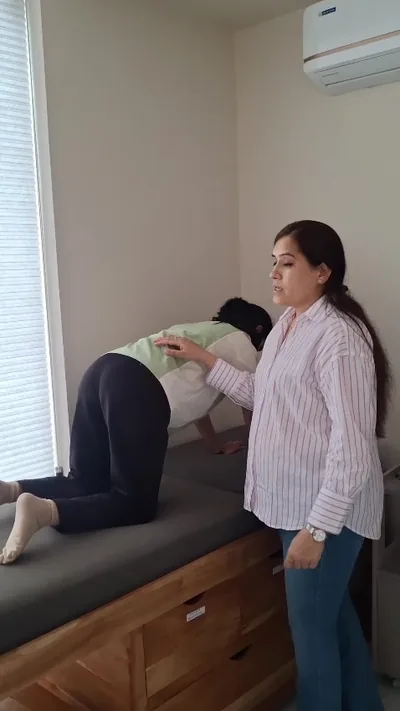
Cat-Cow Pose: On all fours, hands under shoulders, knees under hips. Inhale and arch back down, lifting head and tailbone. Exhale and round spine up, tucking chin. 8-10 times. Eases back tension and improves spine mobility. Keeps blood flowing to pelvic area.
Seated Piriformis Stretch: Sit on chair edge with feet flat. Cross sore side ankle over opposite knee, forming a figure four. Keep back straight and lean forward from hips until stretch in buttock. Hold 20-30 seconds per side, breathe evenly. Targets buttock muscles pressing the nerve. Repeat twice.
Modified Child’s Pose: Kneel with knees wider than hips for belly room. Big toes touch, sit back towards heels as far as comfortable, arms extended forward. Rest forehead on mat if easy. Hold 30 seconds, breathing deeply. Relaxes lower back and hips. Eases pressure from tight glutes.
Figure-Four Stretch Lying Down: Lie on back with knees bent, feet flat. Cross sore side ankle over opposite knee. Loop hands behind uncrossed thigh and pull gently towards chest. Keep head down. Hold 20 seconds per side. Targets piriformis muscle directly. Safer than seated version for balance.
Standing Hamstring Stretch: Face wall, hands on it for support at shoulder height. Step sore side foot forward, heel down, toes up. Hinge forward from hips, keeping back leg straight. Feel stretch in back of thigh. Hold 20 seconds per side. Loosens hamstrings that tug on lower back.
Progress by holding longer as comfort allows. A physiotherapist can check form and add variations during in-person session.
Safe Exercises for Pregnant Women with Sciatica
Safe exercises pregnant women with sciatica build strength in core, glutes and legs to support the changing body. They reduce nerve pressure by improving posture and muscle balance. Warm up with 2 minutes marching in place or arm circles. Do exercises 3-4 times weekly, not daily, to avoid fatigue. Rest if pain increases next day. These suit sciatica management in second trimester.
Pelvic Floor Exercises: Sit or stand tall. Squeeze pelvic floor muscles as if stopping urine flow, hold 5 seconds, relax fully 5 seconds. 10 reps, three times a day. Strengthens support for spine and reduces buttock tension.
Wall Squats: Stand with back against wall, feet hip-width forward. Slide down until knees at 90 degrees or less if tight, thighs parallel to floor. Arms out for balance, hold 10 seconds. Slide up. 5-8 reps. Builds leg and glute strength without forward lean.
Side-Lying Leg Lifts: Lie on side, bottom arm under head, top leg bent for stability. Lift top leg straight 20 cm, foot flexed, hold 2 seconds, lower slowly. 8-10 reps per side. Strengthens hip muscles that stabilise pelvis.
Swimming or Water Walking: In chest-deep pool, walk forward 10 minutes or do gentle kicks holding pool edge. Twice weekly. Water buoyancy unloads spine and allows full movement range without pain.
Add bridges if comfortable: Lie on back, lift hips slightly, hold 5 seconds. Physiotherapist guides safe progression.
Additional Tips to Manage Sciatica in Pregnancy
Stand tall with weight even on both feet, knees soft. Use lumbar roll or small pillow when sitting to support curve.
Apply warm compresses 15 minutes to relax muscles, or cold packs wrapped in cloth for sharp pain, 10 minutes on and off.
Walk 10 minutes on flat ground in supportive shoes with good arch support. Avoid uneven paths.
Sleep on unaffected side with pillow between knees and another under belly for alignment.
Avoid heavy lifting, twisting or crossing legs. Use pregnancy support belt around pelvis during activity, tighten as needed.
Sit with feet supported on stool, change position hourly. Stand to cook or work at counter.
Physiotherapy Approach to Pregnancy Sciatica
A physiotherapist starts with full assessment: checks posture, leg strength, nerve tension tests like straight leg raise, and pelvic alignment. They look for muscle imbalances common in second trimester. Hands-on Manual Therapy releases tight spots in back, glutes and piriformis. Electrotherapy uses electrical pulses to soothe nerve pain and reduce swelling. Custom exercises target weak areas. You may also find Pregnancy Hip Pain Second Trimester Stretches useful.
When to Seek Physiotherapy for Pregnancy Sciatica
Managing sciatica second trimester works best early. See your doctor first for severe pain, numbness in saddle area (inner thighs or genitals), leg weakness, or bladder or bowel changes – these need urgent check. See physiotherapist if home care like stretches helps little after a week, or pain disrupts sleep or daily tasks. Book in-person assessment to get personal plan. Early care prevents worsening.
Common questions
What causes sciatica in the second trimester of pregnancy?
Pressure on sciatic nerve from growing uterus, hormones loosening joints, tight buttock muscles and fluid swelling.
Are stretches safe for sciatica during pregnancy?
Gentle ones like pelvic tilts and cat-cow are safe in second trimester if doctor approves and you stop for pain.
How can I relieve sciatica pain in pregnancy?
Use safe stretches, maintain good posture, apply heat or cold packs, take short walks and sleep with knee pillow.
When should I see a physiotherapist for pregnancy sciatica?
If pain persists despite home care for a week or limits activity.
Can physiotherapy help with sciatica in second trimester?
Yes, through assessment, hands-on release and tailored exercises.
What stretches are best for sciatica pregnancy second trimester?
Pelvic tilts, cat-cow, seated piriformis, modified child’s pose, figure-four and hamstring stretches.
Is sciatica during pregnancy normal?
It affects many but varies; gentle management helps most.
Can exercises worsen sciatica in pregnancy?
Yes, if too intense or poor form; stick to gentle, guided ones and stop for increased pain.
What does a physio session for pregnancy sciatica involve?
Posture and strength check, Manual Therapy for tight muscles, Electrotherapy for relief, plus home exercise plan. Visit Trivayāu Physio Center in Vaishali Nagar or Vidyadhar Nagar. Book via WhatsApp or call +91 90570 65065.
Physiotherapy is not the right first step for everything. Seek medical assessment promptly if any of the following apply to you:
A fit or a blackout, or if you collapse or cannot be woken properly. Call an ambulance or get to the nearest hospital emergency department.
Any bleeding from the vagina, or any fluid leaking or gushing from the vagina, at any stage of pregnancy. If the bleeding is heavy, or you also have severe tummy pain, pain in the tip of your shoulder, or you feel faint or dizzy, call an ambulance.
Your baby moving less than usual, or any change in the usual pattern of movements. Call the hospital where you are booked straight away, even in the middle of the night. Do not wait until morning, and do not try to get the baby to move first.
A severe headache that will not settle, blurred vision or flashing lights, sudden swelling of your face, hands or feet, pain just under your ribs, or feeling very unwell or being sick. Get your blood pressure checked the same day.
Severe, constant or one sided pain in your tummy, pain that does not settle after resting for 30 to 60 minutes, or a tummy that feels hard, tight and tender to touch.
Before 37 weeks: regular tightenings or contractions, period type cramps, or a backache that is not usual for you. Call the hospital where you are booked the same day.
Numbness or pins and needles around your back passage, your genitals or your inner thighs, losing control of passing urine or opening your bowels, not being able to pass urine at all, or new weakness or loss of feeling in one or both legs. Go straight to a hospital emergency department. Pregnancy does not explain these symptoms and they have to be treated within hours.
Pain in your back or in your side just below the ribs along with a temperature, shivering, vomiting, or feeling cold and clammy, whether or not it stings when you pass urine. Also get checked the same day for burning when you pass urine, needing to pass urine far more often than has been normal in this pregnancy, or urine that looks cloudy, pink, red or brown.
Pain, swelling, warmth or redness in one leg, or one leg, thigh, groin or buttock looking bigger or feeling heavier than the other. Go to hospital the same day. Do not wait to see whether it settles, and do not assume that swelling higher up the leg is ordinary pregnancy swelling.
Sudden breathlessness, breathlessness when you lie down, chest pain, coughing up blood, a racing heart, or feeling faint. Call an ambulance and do not wait to see whether it settles.
Any fall, road accident, or knock to your bump, even if you feel completely well afterwards. Get checked the same day.
Pain following a significant fall, road accident or other major injury
Fever, chills or feeling generally unwell alongside the pain
Weakness that is getting worse, or numbness that is spreading
Unexplained weight loss, or a past history of cancer
Pain that is constant, wakes you at night and does not change with position
If you lose control of your bladder or bowels, develop numbness around the groin, or have chest pain or breathlessness, treat it as an emergency and go to hospital.
Safety limits and when this does not apply
We treat only the muscle and joint side of pregnancy pain. The doctor looking after your pregnancy stays in charge of your antenatal care, so keep every scan and check up, and anything in the list above goes to them or to a hospital, not to us. Check with them before you start or change any exercise programme, particularly if you have been told you have high blood pressure, a low lying placenta, a twin pregnancy, a stitch in the cervix, or you have had any bleeding or early contractions.
Shortwave diathermy and TECAR are not used anywhere on the body during pregnancy, and therapeutic ultrasound is never applied over the tummy. Electrotherapy, laser, dry needling and acupuncture are not applied over the abdomen, low back or pelvis at any stage of pregnancy.
Spinal manipulation, traction and forceful hands on techniques are not used during pregnancy.
Do not lie flat on your back for long periods, particularly after 16 weeks, because the weight of your bump presses on the main blood vessel bringing blood back to your heart and this can make you feel faint. Work in side lying or propped up instead, and change position if you feel dizzy or sick. Do not let yourself get overheated either: no hot packs or deep heat over the tummy or low back, no sauna, no hot yoga, and no strenuous exercise in hot weather.
Pregnancy hormones make your joints looser, so stay inside a comfortable range. Avoid end range stretching, deep or wide squats, wide leg movements and standing on one leg to dress, avoid heavy lifting, and never hold your breath and strain. Take care with anything where you could fall or be knocked in the tummy. Stop straight away and get advice if an exercise brings on tummy pain, tightenings, dizziness, breathlessness at rest, chest pain, a headache, any leaking of fluid, or any bleeding.
This article is general information. It is not an assessment of your problem, and it cannot account for your medical history, medication or imaging.
A patient's experience
Truly thankful to Dr. Jyoti Choudhary and the entire team of Trivayu Physio Centre for their genuine care, humble behaviour, and excellent treatment.
Mahesh Dhaka, Google review
This is one patient's own account, published with consent on our reviews page. It describes their experience, not a predicted outcome. Individual results vary.
Evidence. Guidance on musculoskeletal pain here follows the 3 sources listed under References above.
Clinical experience. Practical points on what tends to help in the clinic reflect the experience of the Trivayu physiotherapy team in Vaishali Nagar, Jaipur, and are not the same as trial evidence.
Opinion. Where we suggest a preference or an approach, that is our clinical judgement. Other qualified clinicians may reasonably differ.
Backward walking helps athletes recover from ACL injuries. It builds knee stability in Phase 2 of rehab. This exercise targets quadriceps and improves control after surgery…
After ACL surgery, rebuilding knee strength takes time and care. ACL rehabilitation phases guide this process step by step. Phase 1 protects the graft and cuts…
After hip replacement surgery, dressing your lower body safely helps build independence. By week 6 of hip replacement recovery, many patients aim to dress without help.…