Rotator Cuff Exercises Jaipur Post Injury
Rotator cuff injuries affect muscles and tendons around the shoulder joint. These hold the arm bone in place. Active adults in Jaipur get them from sports,…
Read article

The short answer
Knee pain while climbing stairs commonly affects middle-aged adults in Jaipur with multi-storey homes, worsened by early knee arthritis due to increased joint load and friction. Simple daily changes like holding handrails, leading with the stronger leg up and weaker down, and home exercises reduce knee pressure. Professional assessment is advised for persistent pain.
Knee pain while climbing stairs is a common complaint for middle-aged adults in Jaipur. Many live in multi-storey homes where stairs are used several times a day. Early knee arthritis often makes the pain worse when going up or down. Simple daily changes and careful movements can reduce knee pressure stairs and help you move with less discomfort.
This article shares step-by-step strategies you can start today. These are general suggestions only. An in-person assessment is important for your specific condition.
When you climb stairs, your knee joint bears several times your body weight. The patella, or kneecap, slides over the femur as the knee bends. In early knee arthritis the cartilage surface becomes less smooth. This causes friction and pain exactly when the knee is under load.
Going up increases force through the front of the knee. Going down requires controlled lowering, which can strain the joint further. Multi-storey homes Jaipur make the problem common because residents must use stairs repeatedly without long flat surfaces to rest the knees. The pain is often felt on stairs but not on flat ground because the joint angle and load are different.
Small changes in how you use stairs can lower discomfort. Always hold the handrail with the hand closest to it and keep your body close to the rail. This takes some weight off the painful knee.
Use a step pattern that avoids deep bending. Place the stronger leg first when going up and lead with the weaker leg when going down. Take one step at a time rather than two. Pause on landings to let the knee rest. Good lighting on staircases prevents missteps that jar the joint.
Simple home adjustments help. Install a second lower handrail if only one exists. Add non-slip strips on worn steps. Keep stairs clear of clutter. These knee friendly home adjustments reduce knee pressure stairs without major renovation. Looking for a Physiotherapist in Jaipur? Our team in Vaishali Nagar, Jaipur can assess you in person.
Gentle exercises build support around the knee. These are general examples only. Stop if pain increases sharply. Perform them on a flat surface with good footing.
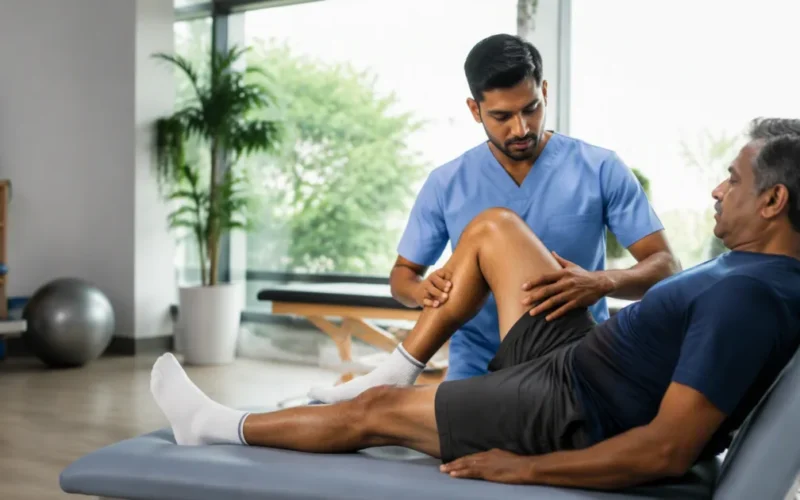
Seated leg lifts: Sit on a firm chair. Straighten one knee and lift the foot until the leg is level. Hold for five seconds. Lower slowly. Repeat ten times each leg.
Wall sits: Stand with back against a wall. Slide down until knees are bent at a comfortable angle, no more than thirty degrees. Hold for ten seconds. Slide back up. Build time gradually.
Low step-ups: Use the bottom stair or a sturdy platform no higher than ten centimetres. Step up with the weaker leg first, then bring the other foot up. Step down slowly. Do eight to ten repetitions.
Quadriceps stretch: Stand holding a chair. Bend one knee and bring the heel toward the buttock. Keep knees level. Hold twenty seconds. Repeat both sides. Read more about our Home Visits.
Calf stretch: Face a wall. Place one foot back. Keep the back heel down and lean forward until you feel a gentle pull in the calf. Hold twenty seconds. These moves help strengthen knees at home when done regularly with proper form.
Apply an ice pack wrapped in cloth to the painful knee for ten to fifteen minutes after stair use. This calms swelling. Rest with the leg elevated on a cushion so the knee is slightly higher than the hip.
Gentle circular massage around the kneecap can ease tight tissues. Avoid deep pressure directly on the joint. Do not massage if the knee is hot or very swollen.
Choose flat footwear with good support. Avoid high heels or completely flat slippers on stairs. If pain appears during an activity, stop and walk on level ground instead. Persistent or worsening pain needs professional assessment rather than continued home care alone.
Home strategies are useful but not enough when pain limits daily movement, swelling lasts more than a few days, or the knee feels unstable. Locking, giving way, or pain that disturbs sleep are signs to get expert help. You may also find Knee Pain While Sitting Cross Legged: Daily Adjustments useful.
A physiotherapist can assess the exact cause and provide manual therapy, advanced electrotherapy, or a personalised exercise programme. At Trivayu Physio Center in Vaishali Nagar and Vidyadhar Nagar, the team offers orthopaedic physiotherapy, sports injury rehab, post-surgery rehab, and pain management. Techniques include Class IV High Power Laser Therapy, TECAR Therapy, Robotic Spinal Decompression Therapy, dry needling, manual therapy, myofascial release and clinical Pilates. The experienced staff give clear explanations and focus on long-term recovery.
Stair climbing bends the knee under body weight. On flat ground the knee stays in a smaller range of motion with less load. Early knee arthritis makes this loaded bending painful.
Use handrails correctly, improve lighting, add non-slip treads, install a second handrail if needed, and keep stairs clear. These reduce knee pressure stairs and improve safety.
Seated leg lifts, wall sits at shallow angles, low step-ups and gentle quadriceps and calf stretches can strengthen supporting muscles. Perform with correct form and stop if pain increases.
See a physiotherapist if pain continues despite home care, swelling persists, the knee feels unstable, or daily tasks become difficult. Early assessment prevents worsening.
Many people manage knee pain on stairs with physiotherapy, exercise, and daily adjustments. Recovery varies. A proper assessment determines the best plan for your case.
Small consistent changes can make stairs less painful. Start with the habits and movements that feel easiest. For lasting relief and a tailored plan, book an assessment at Trivayu Physio Center. Call +91 90570 65065 or message on WhatsApp to arrange a convenient time.
Physiotherapy is not the right first step for everything. Seek medical assessment promptly if any of the following apply to you:
If you lose control of your bladder or bowels, develop numbness around the groin, or have chest pain or breathlessness, treat it as an emergency and go to hospital.
I highly recommend Jyoti Ma'am and her team. I first visited her for a ligament injury in my knees, and with her expert treatment and therapies, I made a complete recovery.
Richa Tailang, Google review
This is one patient's own account, published with consent on our reviews page. It describes their experience, not a predicted outcome. Individual results vary.
Rotator cuff injuries affect muscles and tendons around the shoulder joint. These hold the arm bone in place. Active adults in Jaipur get them from sports,…
Read articleOffice workers in Jaipur often feel elbow pain from laptop use. This comes from hours of typing and poor posture. Repetitive strain builds up in the…
Read articleWhat is Prehab for ACL Tear? Prehabilitation, or prehab, means exercises and therapy before ACL surgery to prepare your knee. An ACL tear happens when the…
Read articleMessage us on WhatsApp with your main concern and preferred time, and we'll confirm your first visit the same day.